Celebrant-Led Ceremony, Church, or Civil Registry Office?

"Do you want to be my wife?"
"Yeah, sure, but how?"
Even though your engagement hopefully didn’t go quite like that, it’s a valid question. At some point, you’ll have to decide whether you want to get married in a church, at a civil ceremony, in a non-religious ceremony, or with a combination of these options. In this blog post, we’d like to explain the differences between these three types of weddings and help you decide which option is right for you.
This article covers the following topics:
Civil Wedding Ceremony
We’ll start with the civil wedding ceremony, because it’s the only one you can’t avoid if you want to be legally married in Germany. Even though purely religious wedding ceremonies have been legally permitted since 2009, they have no legal effect.
The civil wedding ceremony is conducted by a civil registrar and typically takes place at the registry office. In many Bavarian cities and municipalities, however, it’s possible to get married at so-called “special venues”: for example, in a castle, at a mountain hut, or at other suitable wedding venues. The prerequisite for this is that the location is within the respective registry office district and that official approval has been granted. For such weddings held outside the registry office building, an additional fee is usually required. Even for a wedding at a special location, the presence of a registrar is mandatory. The ceremony itself—especially in a traditional setting—is usually kept fairly short and formal. However, many registry offices strive to add a personal touch to make the moment special for you.
By the way, having witnesses is optional in Germany—you can name up to two, but you don’t have to. Important to know: After filing your marriage registration—which you can submit no earlier than six months before your desired date—the wedding ceremony must take place within this timeframe. Many couples therefore choose to hold the civil wedding ceremony on a small scale and on a separate day before the big celebration—for example, followed by a reception. This relieves the time pressure and gives you more time to enjoy the occasion. Civil weddings in Germany are generally only possible on weekdays—that is, Monday through Friday during office hours. Many civil registry offices also offer appointments on Saturdays, especially in larger cities or for weddings at special venues; however, this is optional and usually involves additional costs. Weddings are generally not possible on Sundays or holidays. We recommend registering with the civil registry office well in advance, especially for Saturdays or special venues in the summer, as these wedding dates are in high demand.
Tip: Since 2024, it’s been possible to have digital marriage certificates issued—which is convenient, since marriage certificates are often needed later as proof of marriage.


Church Wedding
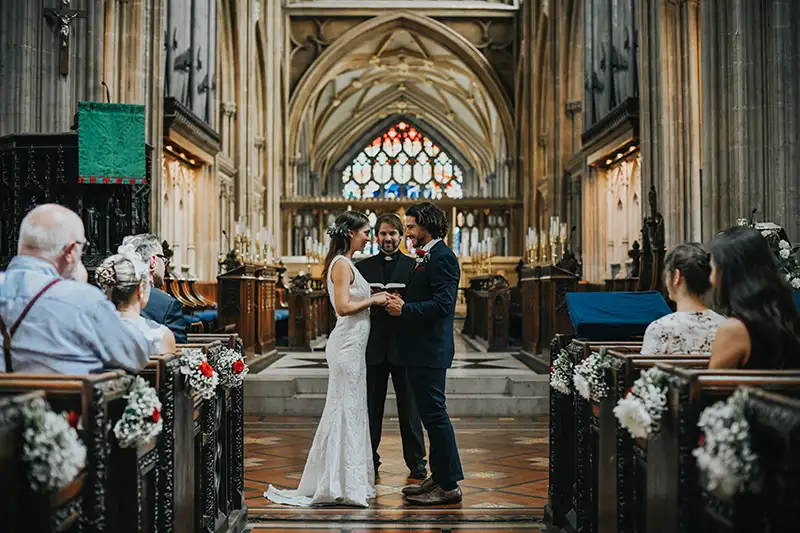
A church wedding is a marriage ceremony that takes place in a church or other religious building. It is conducted by a clergy member and usually follows a set liturgical order. While in Austria and Switzerland it is still required to have a civil marriage ceremony first, the following applies in Germany: Since the reform of the Civil Status Act took effect on January 1, 2009, it has been legally permitted there to have a purely religious wedding—that is, without a prior civil marriage ceremony.
But be aware: A wedding ceremony held exclusively in a church has no legal effect—the couple is not considered married under civil law. This does not give rise to any tax, inheritance, or insurance-related rights. In practice, the situation is different in most cases anyway: The Evangelical Church sticks to its existing model and performs weddings only after the civil marriage has taken place. A purely religious wedding without a civil marriage is virtually impossible here. In the Catholic Church, exceptions are possible under certain conditions—for example, with a dispensation from the bishop.
For many people, the great value of a church wedding lies in its profound spiritual significance. It is a way to seal their love before God and the congregation—and it also offers devout couples the opportunity to receive the sacrament of marriage, which is of special importance to some.
Of course, when it comes to a church wedding, the question arises as to whether you as a couple share the same religious beliefs. If you belong to different religions or if one of you has no religious affiliation, there are various options depending on your specific situation. For example, a church wedding for a Protestant-Catholic couple, neither of whom has been married before, is usually relatively straightforward. Things become more complicated if the religions differ significantly in doctrine and practice, or if one partner is already divorced. If this applies to you and you still wish to have a church wedding, it’s best to contact your local clergy or the relevant parish directly. The circumstances vary too widely—and ultimately, much depends on the decision of the respective clergy member.
A church wedding is more than just a festive setting—it offers you the opportunity to say “I do” in front of your family, friends, and faith community. Those who consciously choose this path can look forward to atmospheric rituals, profound moments, and, last but not least, a lovingly decorated church or place of worship.

Humanist ceremony
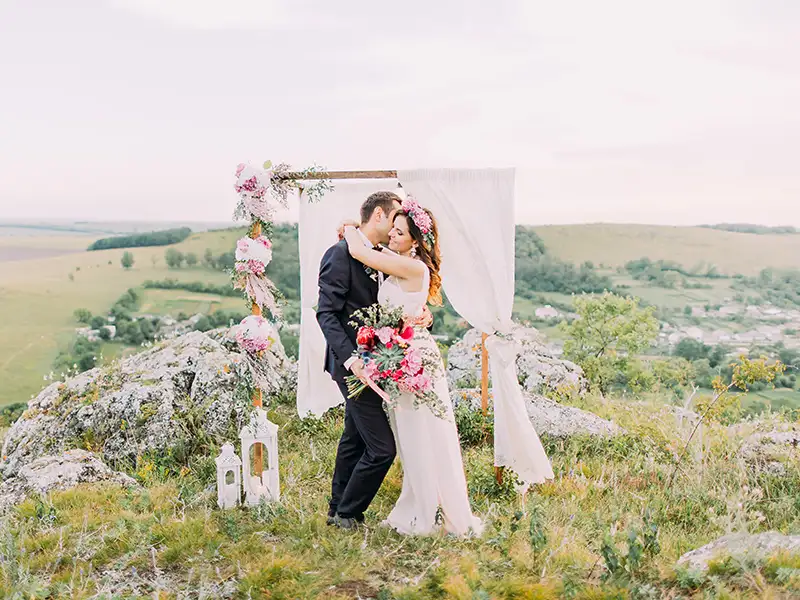
An independent wedding ceremony is a ceremony conducted by an independent wedding officiant. You have complete freedom to choose where it takes place. This means you can decide for yourselves whether you want to celebrate your love on a beach, on a mountain peak, in a forest clearing, in a castle, or in your own home. Many wedding venues also offer beautiful settings for a romantic wedding ceremony.
There are many ways to customize your non-religious wedding ceremony to suit your preferences. For example, you can incorporate music, readings, and other rituals and elements to give the ceremony a particularly personal and emotional touch.
However, in Germany—just as in Austria and Switzerland—a non-legal wedding ceremony isn’t legally binding. This means that if you want to be legally married and share the same last name, you’ll have to go to the registry office. If you don’t want to, you don’t have to make a big deal out of it—you can treat the signing as just a routine visit to the office—much like picking up a new passport.
Created on
10.2.2023
Updated on
14.7.2025