How Much Does a Wedding Cost? The 9 Biggest Budget Items and How to Save

We’re going to get right to the point to tell you something that’s a bit unpleasant but also probably the most important thing you need to keep in mind from the very beginning when planning your wedding: A wedding costs money. And not just a little. Most couples start planning their wedding naively (often practically blindly) by getting quotes, are then in for the shock of their lives, get angry at every wedding vendor in the world, and only then start thinking about their wedding budget.
We’ll help you accurately calculate and estimate your wedding costs. To ensure you don’t end up spending more than you intended on your wedding day, there are a few things to keep in mind. We have the right tips and tools to help you allocate your expenses effectively, track your wedding budget—and, most importantly, plenty of advice on how to save money on your wedding.
Planning a Wedding: Costs & Budget
It’s all about the money—because, of course, as a couple, you’re really looking forward to your wedding, but at some point, the financial question always comes up. How much will our wedding cost? What major expenses should we expect for our celebration, and where are the hidden costs? If you have absolutely no idea, you’re not alone—most couples can’t estimate how much a wedding will cost at first. After all, you usually only plan your wedding once. So how are you supposed to know what a wedding invitation or a wedding ring costs? It’s a good thing we’re experts on the subject and can help you with your wedding budget and the financial planning for your wedding…
This article covers the following topics:


Wedding Budget: First Steps
Before you even start getting quotes, you need to be very clear about how much of a budget you have available for your wedding. Only then can you focus on the individual cost items or wedding vendors.
Set a fixed budget!
It should be clear that a wedding isn’t a cheap affair. That’s why you should start by setting your budget before you ask wedding venues or vendors about their prices. “We don’t know yet” or “we’ll see” are all lame excuses. Everyone has a set budget. Everyone has a maximum amount they’re willing to pay. It’s the same when buying a car, paying rent, traveling, and everything else. It’s even more important when it comes to a wedding because many individual costs add up to the grand total. Many vendors will ask you about your budget. But they don’t do this because they want to stretch it to the limit. Rather, it’s because there are different options they can offer you depending on your budget. Just like at a car dealership or a travel agency: a Ferrari or a Honda; Hawaii or Mallorca.
What is a realistic budget?
Of course, planning a wedding budget is difficult, because it’s usually your first time getting married. You’ll find wildly varying figures online, because, unfortunately, a lot of that information is outdated. And, of course, you don’t necessarily want to ask your newlywed friends how much they spent on their celebration. So how are you supposed to know what’s realistic? Exactly: you don’t know. But that’s exactly why you shouldn’t react with annoyance when a quote from an oh-so-evil, rip-off service provider lands in your inbox. If you don’t understand a quote, they’ll be happy to explain why it’s structured that way—what’s going on behind the scenes, and what effort and costs the provider incurs. In the end, you’ll understand!
Cost Allocation as a Game-Changer
Preparation is everything! This also applies to planning the budget for your wedding celebration. Because once you understand what the actual costs are and can prioritize the individual wedding vendors accordingly, it’ll be easier for you to plan your budget and, if necessary, adjust it a bit. Often, when couples plan their wedding and budget carefully, they discover that the things that matter most to them are quite different from what they might have thought at the beginning of the planning process.
Prioritizing services and allocating budgets is a real game-changer when it comes to sticking to your wedding budget. To give you an idea of what individual categories of your wedding cost, we’ve put together an overview of the average prices per category for you:


1. Cost of the wedding venue
The cost of your wedding venue ranges from €500 to €8,000. Yes, we realize that this estimate leaves a lot of wiggle room. But unfortunately, we can’t assess your specific needs and wishes for your wedding from a distance. A small venue in a restaurant is, of course, less expensive than a banquet hall for 200 people. But one thing will certainly become clear to you regarding this item: The wedding venue is one of the biggest expenses for your wedding!
Cost of the wedding venue:
Estimated range: 500 to 8,000 euros
2. Food and Catering Costs
Whether you choose a regular catering partner or in-house catering, you’ll always need to set aside at least 20 percent of your total budget for food and drink. When deciding for or against professional catering, we would—from a financial standpoint—always lean toward a catering partner. That’s because many couples misjudge this: Especially if you don’t have the necessary infrastructure for catering, you’ll face huge additional costs for equipment, tableware, heating, and so on. With a catering package, on the other hand, even the service staff is included in the price. Specific costs for catering at your wedding? These typically range from 80 to 300 euros per person.
Meal and catering costs:
Estimated cost: 80 to 300 euros per person


3. How much does a wedding photographer or videographer cost?
About ten to fifteen percent of your total wedding budget will likely go toward the photographer. That might sound like a lot at first, but when you realize that the photographer—or even a videographer—is capturing nothing less than the memories of your wedding, you’ll see that this expense is justified in the long run. The cost of wedding photos ranges from 500 to 5,000 euros. Yes, there’s a wide price range here as well—but some photographers offer comprehensive packages covering everything from the “getting ready” phase through the late evening hours, while others charge by the hour for their wedding photography services. The price often includes not only the photographer’s presence during the event but also photo editing and the delivery of images and videos via USB drive, website, or other digital formats. Some wedding photographers will even create a high-quality photo album for you.
Even though we’re starting with a guideline of 500 euros, you should be prepared to spend a bit more when it comes to wedding photography. After all, you shouldn’t expect too much from an amateur photographer who charges five hundred euros or less. So many couples have told us about bad experiences with unprofessional photographers—so it’s better to hire a professional wedding photographer, pay a little more, and in return have beautiful memories that will last a lifetime. If you have to cut back on expenses, it’s better to do so in other areas.
Costs for a wedding photographer and videographer:
Estimatedrange: 500 to 6,000 euros


4. Wedding Budget for Music
We’d recommend setting aside about 10 percent of your total budget for this. While the cost for musical accompaniment during the reception starts at around 200 euros, a full program of musical entertainment for the wedding is more expensive: If you want music for the ceremony, a wedding band in the evening, and a wedding DJ to wrap things up, about 4,000 euros is quite typical. When calculating costs, keep in mind that it always depends on how many people are on stage, since they have to split the fee—so a five-piece band is more expensive than a single singer-songwriter. Additionally, the time of day and the duration of the event are important factors; for the evening program, for example, musicians have to bring a lot of equipment, and that also adds to the cost.
Costs for wedding music:
Estimatedrange: 200 to 4,000 euros
5. Stationery Costs
Finally, a cost that stays within reason. But it’s important to note: Making your own cards takes a lot more effort than using invitations designed by professional stationery designers! Depending on whether you want to send save-the-date cards, invitations, and thank-you cards—and whether you also want to order name cards, menu cards, place cards, a seating chart, and favor tags—you can get by with a budget of about 2–5 percent of your total budget. Of course, there’s virtually no upper limit here either—invitations with gold foil stamping, wax seals, and handmade paper cost more than standard cards. Costs for wedding stationery and invitations range from about 200 to 5,000 euros—depending on whether you make them yourself, order them from a well-known online store, or have them custom-made by wedding stationery professionals in Bavaria.
Costs for wedding stationery:
Estimatedrange: 200 to 5,000 euros


6. Jewelry and Wedding Rings
Wedding rings may be small, but you shouldn’t underestimate the cost—prices naturally vary depending on the material and special features (such as gemstones). Prices for wedding rings start at around 1,000 euros.
Here's how much wedding rings cost:
Approximate price range: 1,000–2,000 euros
7. Budget for Flowers and Wedding Decorations:
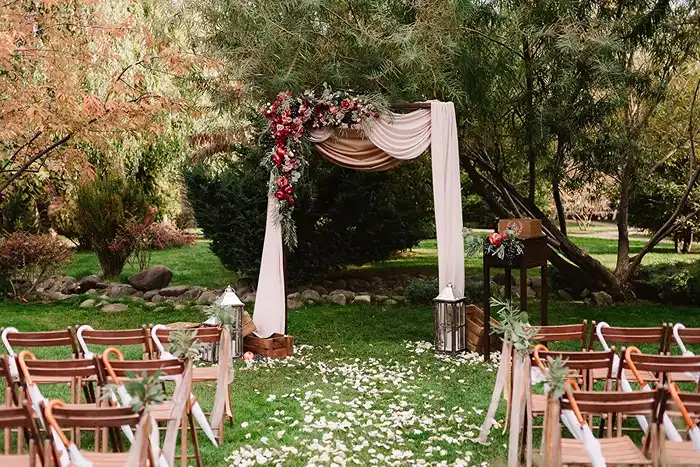
Floral arrangements, bridal bouquets, floral displays, table decorations, car decorations, chair covers, and other wedding decorations & furniture account for an average of 10 percent of the total wedding budget—though there’s virtually no upper limit in this regard, especially if you want very lavish floral decorations, rent chairs and a wedding arch, and want the table decorations to be particularly opulent. If you hire a professional wedding florist, you won’t have to worry about decorative elements either, since these decorations are provided—so you won’t have to go through the hassle of selling vases, candles, and the like later on.
Costs for floral arrangements and decorations:
Estimated range: 500 to 10,000 euros


8. Wedding Budget: The Ceremony
The costs for the wedding ceremony include the rental fee for a church, civil registry office, or other venue, as well as—in the case of a non-religious wedding—the fees for a professional wedding officiant, which start at around 1,000 euros.
Cost of the wedding ceremony:
Estimated cost: 200–2,000 euros (depending on the type of wedding ceremony)
9. Cost of the wedding dress and suit:
This expense category includes the cost of your wedding suit, your wedding dress, accessories such as earrings and hairpieces, shoes, a purse, and the hair and makeup artist. The wedding dress and all other key elements of your final wedding look will cost you about 10 to 15 percent of your total budget.
Costs for the wedding dress and other items:
Approximate range: 1,000–3,000 euros


Saving Money on Your Wedding
As youcan see, there are quite a few costs you’ll have to factor in as a couple planning a wedding. Fortunately, though, there are also ways to save money and stay within your wedding budget:
- Choose a later date! This is recommended not only because it gives you a little more time to save up for your big day, but also because a later date makes wedding planning much easier overall. Not all venues and vendors are fully booked—so you can take your pick and secure the vendors for your wedding that fit your budget. Plus, you’ll naturally be able to approach the whole thing much more relaxed when you know the big day isn’t just the day after tomorrow.
- Shorten your guest list! After all, especially when it comes to the most expensive item—food and drinks—you’re paying a per-person price. Take that per-person cost (drink package, meal, wedding cake, etc.) and think very carefully about each individual guest on your list: are you really willing to spend that much on just that one guest? If in doubt, cross off anyone you’re even slightly unsure about, even for just a moment. Just ten fewer guests can already mean huge savings! Skip inviting that coworker you haven’t seen in years, and invest the money instead in something you really want for your wedding.
- Reducing staff, for example by opting for a buffet instead of a sit-down meal, can also save money.
- It's also cost-effective to hold all wedding activities in a single location. A venue that's close to the registry office—and that even hosts the reception and then handles all the wedding planning—will save you money.
- Consider holding your wedding during a less popular season or on a weekday to save even more money. A later ceremony shortens the time between the ceremony and dinner, which reduces food consumption. Paradoxically, consulting with a wedding planner can actually lower costs significantly, since they’re aware of hidden cost pitfalls.
- When it comes to wedding dresses, it's worth asking about last year's styles. Consider whether you can rent certain items instead of buying them.
- If you prefer an intimate wedding, you generally don’t have much to worry about in terms of cost. If you’re the elopement type, you can spend the money you’ve saved on your dream wedding—whether that’s a trip to your elopement destination, a great photographer, or a haute couture wedding dress.


We just can't afford everything. What should we cut?
You’ve now come to terms with the fact that a wedding costs what it costs and that, unfortunately, you can’t afford everything. We’d like to congratulate you on that, because many couples, blinded by rose-colored glasses, never even get to this point. But what now?
Set your priorities! Unfortunately,you can’t always have it all. What’s particularly important to you, and what could you do without if you had to? What’s a must-have for you, and what’s just a nice-to-have? Make a list and rank each item by importance. But don’t forget that there are some things you really should leave to the pros instead of doing them yourself—especially if they’re important to you. Photos by Uncle Raimund, homemade invitations, Aunt Gerti’s cake, or that secondhand wedding dress from the internet… all of these can very quickly turn into a wedding nightmare.
Wedding Budget FAQ
We’re constantly asked the same questions about wedding budgets—that’s why we’ve put together this concise summary for you.
How much does a wedding cost?
The budget for a wedding depends heavily on individual preferences and local circumstances. On average, couples in Germany and Austria spend between 10,000 and 20,000 euros. However, it is possible to plan a wedding for less—or for significantly more.
What expenses are essential to consider when planning a wedding budget?
Major expenses include the cost of the venue, catering, wedding attire, the photographer, decorations, music, invitations, and possibly lodging for guests. Also important to consider are the costs of the wedding ceremony itself, whether it’s a civil, religious, or non-denominational ceremony.
What's the best way to save money on a wedding?
You can save money by, for example, keeping your guest list smaller, booking a venue outside of peak season, or opting for an all-inclusive package (catering, venue, wedding planning). Careful planning and booking early can reduce costs. As a general rule, choosing a later wedding date saves money. For one thing, you’ll have more time to save up, and for another, you’ll avoid the pressure that comes with wanting to get married in just two weeks—which would limit your options significantly. And when you’re not working under time pressure, you’ll simply plan more rationally, efficiently, and effectively.
Should you include a financial buffer in your wedding budget?
Yes, it's a good idea to set aside a buffer of about 10–15 percent of the total budget. Unforeseen expenses can always come up, and a buffer helps you handle them without stress.
What's the best way to allocate the budget among the various line items?
You can read more details about how to allocate your wedding budget in our blog post. A common breakdown looks something like this: 40–50 percent for the venue and catering, 10 percent for attire, 10–15 percent for photography and videography, 10 percent for decorations and flowers, 5–10 percent for music and entertainment, and the rest for various smaller items such as invitations, rings, and transportation. It’s important to tailor this breakdown to your individual needs, depending on what matters most to you as the bride and groom.
Created on
7.1.2020
Updated on
21.7.2025